

The Edith Stein Speaks newsletter breaks down St. Teresa Benedicta of the Cross’ writings into bite sized pieces. They will feature a passage from Edith Stein’s work followed by a short commentary, connecting her work to other notable saints, theologians and modern day thinkers. To read her biography, click here.
We continue our exploration of Edith Stein’s essay “Ways to Interior Silence.” After giving the first moments of the morning to God, she lays out how she attends Mass and is filled with courage and energy for the day ahead from her quiet dialogue with the Lord.
Here are Edith Stein’s words:
“So I will go to the altar of the God. Here it is not a question of my minute, petty affairs, but of the great offering of reconciliation. I may participate in that, purify myself, and be made happy, and lay myself with all my doings and troubles along with the sacrifice on the altar. And when the Lord comes to me then in Holy Communion then I may ask him “Lord, what do you want of me?” (St. Teresa of Avila). And after quiet dialogue, I will go to that which I see as my next duty. I will still be joyful when I enter into my day’s work after [the] morning’s celebration: my soul will be empty of that which could assail and burden it, but will be filled with holy joy, courage and energy.”
Commentary:
At the time of writing this, Edith Stein was a lay woman, teaching at at college. She lived with nuns, and was able to wake early to attend daily Mass. Many may long for an opportunity to do the same, but even if it is not to be so during this season of life, one need not despair of intimacy with Christ. Each of us is offered the opportunities for quiet dialogue during the day; times to go to the altar of God within the heart. Stein writes to say that prayer is not just another task on the to-do list, but a much desired opportunity to lay down one’s burdens and “be made happy.” This happens not through empty words but a deeply personal relationship with the Lord, possible in any situation or circumstance. If reception of the Eucharist is not available, acts of spiritual communion can be turned to at any time. Indeed, go to the altar of God within the soul and lay any burdens down. This is not just a cliché. The physical, mental and spiritual burdens that bring heaviness to the heart can be released into the hands of God. It may be helpful to write them down or to say them out loud as a concrete act of surrender. As Edith says, expect to filled with “holy joy, courage and energy” from times of encountering the Lord.
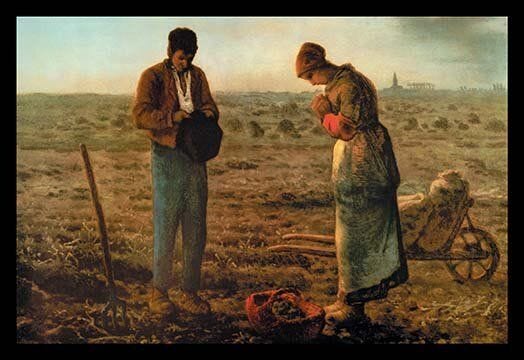
More thoughts from wise people:
“For the Lord does not see as man sees; for man looks at the outward appearance, but the Lord looks at the heart.” (1 Samuel 16:7)
“For the desire of your heart is itself your prayer. And if the desire is constant, so is your prayer.” (St. Augustine)
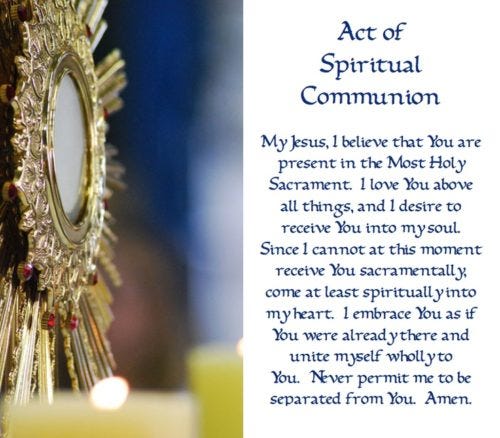
St. Teresa of Avila: "Spiritual Communion is very profitable; therefore do not omit it, for by it the Lord learns how much you love Him."
“For us, who are so frequently concerned with operational effectiveness and with the results … we achieve, the prayer of Jesus is a reminder that we need to stop, to experience moments of intimacy with God, ‘detaching ourselves’ from the turmoil of daily life in order to listen, to return to the ‘root’ which nourishes and sustains our existence. (Pope Benedict XVI)
From Hearing God’s Voice: A Guide to Daily Conversational Prayer by Andre Regnier:
I recognize that for some of you, creating a quiet, dedicated prayer space may seem impossible. This is especially true for mothers with young children. I would like to speak to the mothers out there who are surrounded by children all day. How can you make time to pray each day? I am going to share from the experience of my wife, Angele, and my three daughters, Mylene, Alana, and Elizabeth, who are managing my ten grandchildren.
My daughters do not see prayer as silent “me-time” with God. They see prayer as a time to be in God’s presence and have a conversation with Him. The conversation includes listening, asking questions, and intercessions for others…It is a time for connection, even if that is not done in peace and quiet. When you see prayer as simply a time to get away and be quiet, it will be a challenge to find that time as a mother of small children. If you see prayer as a good conversation, you can have such a conversation when things around you are potentially loud and busy. It is similar to having an important phone conversation with a close friend while children are playing nearby. It can still be meaningful if you need to pause to address a scraped knee or referee a sibling dispute. The key is that you are both committed to the conversation and can easily pick up where you left off.
I have witnessed this principle in action as I observe my daughters. Mylene prays silently as her kids play on the floor next to her. When her children have a question, she puts her journal down, deals with the situation, and then returns to her conversation with God. The interruptions do not destroy her connection or the flow in her prayer. So, peace be with you, mothers! God still desires to have a daily time of conversation with you.